CycleGAN: cycle-consistency is the key
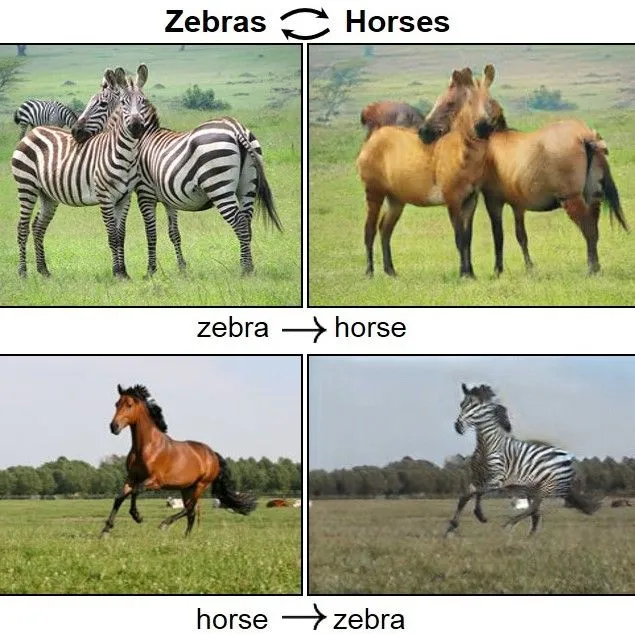
Most image-to-image translation setups assume you have pairs: this photo and its
segmentation mask, this sketch and its finished drawing. pix2pix works
beautifully when you do. The problem is that for a lot of interesting problems
you simply cannot get pairs.
The case I ran into was brain MRI. A T1-weighted scan and a T2-weighted scan show different tissue contrast, and radiologists often want both. Getting both means keeping the patient in the scanner for a second acquisition — more time, more cost, more discomfort. You would like a model that turns one into the other. But a paired dataset would require the same patient, scanned twice, perfectly registered, at scale. In practice you have a pile of T1 scans and a pile of T2 scans from different people, and no correspondence between them.
CycleGAN is the answer to exactly that situation.
The setup
Two domains, X and Y. Two generators:
G: X → YF: Y → X
And two discriminators, D_Y which tries to tell real Y images from G(x),
and D_X which does the same for X and F(y).
The adversarial part is standard. G is trained to produce images that D_Y
accepts as belonging to Y:
# Least-squares GAN loss — more stable than the original log-loss formulation,
# and what the CycleGAN paper actually uses.
def generator_adversarial_loss(fake_scores):
    return tf.reduce_mean((fake_scores - 1.0) ** 2)

def discriminator_loss(real_scores, fake_scores):
    real = tf.reduce_mean((real_scores - 1.0) ** 2)
    fake = tf.reduce_mean(fake_scores ** 2)
    return 0.5 * (real + fake)
Why the adversarial loss alone is not enough
Here is the crux. The adversarial loss only asks one thing of G: that its
output looks like it came from domain Y. It says nothing whatsoever about the
output corresponding to the input.
That constraint is far too loose. G could learn to ignore x entirely and emit
the same convincing Y image every time — it would satisfy the discriminator
perfectly. Or it could permute the mapping arbitrarily: send patient A’s T1 to
something that looks like patient B’s T2. The discriminator has no way to object,
because the result is a perfectly plausible member of Y.
With unpaired data there is no ground-truth target to penalise this with. So you need a different kind of constraint.
Cycle-consistency
The insight is to demand that the translation be reversible:
Translate an image to the other domain and back again, and you should land where you started.
F(G(x)) ≈ x, andG(F(y)) ≈ y.
That is it. That is the whole idea, and it is the reason the architecture works.
def cycle_consistency_loss(real_x, cycled_x, real_y, cycled_y, lambda_cyc=10.0):
    forward = tf.reduce_mean(tf.abs(real_x - cycled_x))   # x -> G -> F -> x
    backward = tf.reduce_mean(tf.abs(real_y - cycled_y))  # y -> F -> G -> y
    return lambda_cyc * (forward + backward)
An L1 loss, weighted heavily — λ = 10 in the paper, which tells you how much of
the training signal actually comes from this term rather than the adversarial one.
Think about what this rules out. If G collapses to a constant output, F
cannot possibly recover the original x from it — the information is gone, and
the cycle loss goes through the roof. If G scrambles the correspondence between
inputs and outputs, F would have to learn the inverse scramble, which is a much
harder function than the identity-preserving one. Cycle-consistency forces the
generators to preserve the content of the image while changing only its style or
modality, because content is precisely the thing that has to survive the round
trip.
It is a soft, self-supervised stand-in for the paired supervision you do not have.
The identity loss
There is a third term that is easy to skip and worth keeping, particularly for medical images:
def identity_loss(real_y, same_y, lambda_id=5.0):
    # G(y) should be y: feeding a generator an image already in its target
    # domain should change nothing.
    return lambda_id * tf.reduce_mean(tf.abs(real_y - same_y))
Without it, generators tend to shift the overall colour or intensity of the image even when they have no reason to. In the MRI case that matters — a global intensity shift is not a cosmetic problem, it changes what the image means.
Architecture notes
The generator in the original paper is an encoder, a stack of residual blocks, and a decoder. The residual blocks are the important part: they let the network learn a modification to the input rather than regenerating it from scratch, which is exactly the right inductive bias when input and output share structure. For 256×256 inputs, nine residual blocks is the standard configuration.
The discriminator is a PatchGAN — instead of one real/fake score for the whole image, it outputs a grid of scores, each judging a 70×70 patch. This pushes the model toward local textural realism and keeps the parameter count down.
Two training details that are not optional in practice:
- Instance normalisation, not batch normalisation. Style-transfer-shaped problems care about per-image statistics, and batch norm mixes them across the batch.
- A replay buffer of generated images. Update the discriminators using a pool of the last ~50 generated images rather than only the current batch. It damps the oscillation that otherwise shows up around epoch 20 and never really settles.
Where it breaks down
Cycle-consistency buys you a lot, but it is not free of failure modes, and it is worth being honest about them:
- Geometry is hard. CycleGAN is very good at texture and colour, and much worse at changes that require moving things around. It will happily restyle a horse as a zebra; it will not turn a cat into a dog.
- Steganography. The network can learn to hide a low-amplitude encoding of
the source image inside the translated output, so that
Fcan reconstructxperfectly without the translation being semantically meaningful. The cycle loss is satisfied; you have been cheated. Chu et al. documented this well. - Hallucination. In a medical context this is the one that matters. The model will produce a plausible T2 scan, and plausibility is not accuracy. A lesion that is not there can be invented; one that is there can be smoothed away. These outputs are a research artefact, not a diagnostic instrument.
What I built with it
I trained a CycleGAN with ResNet blocks on unpaired T1 and T2 brain MRI slices. The code is on GitHub.
PLACEHOLDER — fill this in. Add your own results here: dataset and size, how long training ran and on what hardware, the SSIM/PSNR you reached, and a couple of sample outputs including a failure case. This is the part of the post readers will actually want, and it is the part only you can write.
The takeaway
If you remember one thing: the GAN loss makes the output look right, and the cycle loss makes it correspond to the input. Unpaired translation needs both, and of the two, the cycle-consistency term is the one doing the load-bearing work. Remove it and the model still produces beautiful images — of nothing in particular.
References
- Zhu, Park, Isola & Efros, Unpaired Image-to-Image Translation using Cycle-Consistent Adversarial Networks (ICCV 2017)
- Chu, Zhmoginov & Sandler, CycleGAN, a Master of Steganography (2017)